


Music for Busy Brains: October 2025

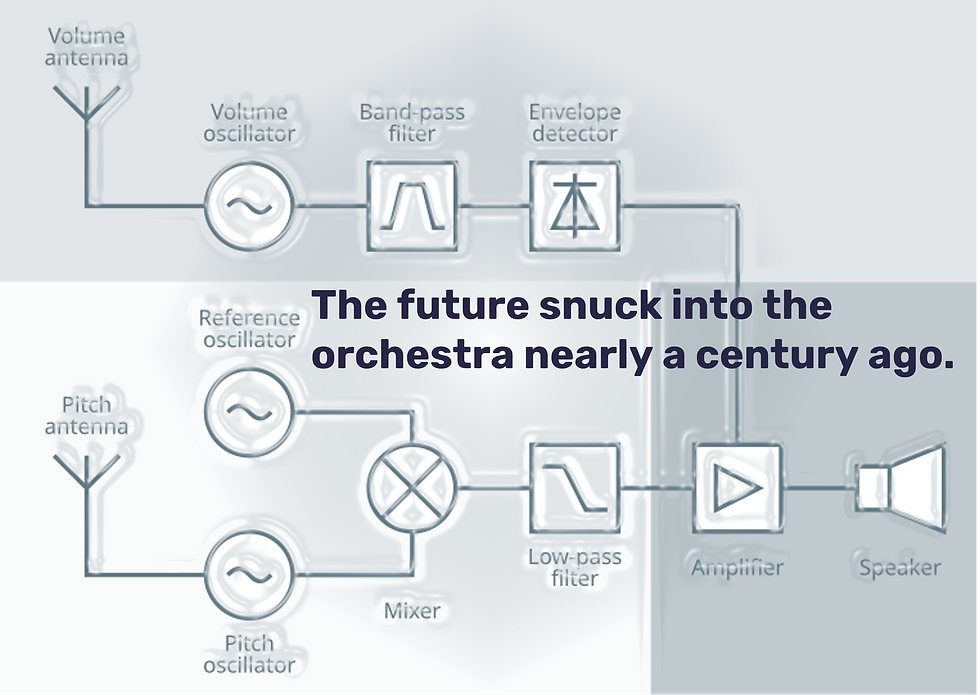
This month I’m focusing on classical music that brings electronic instruments into the orchestra – the theremin and the ondes Martenot. They're perfect for when you really want your brain to go somewhere else.
I’ve always loved a good synth. Growing up, I was permanently plugged into the Pet Shop Boys, New Order, Gary Numan, Eurythmics… basically anything but classical. I wore my Walkmans and tapes out. I didn’t actually start listening to the music I was playing – the very same music I now recommend so heartily – until my twenties. Even now, I do a little jig when I hear Electronic’s Getting Away with It drifting through my local supermarket.
Back in 2009, I was singing with the London Symphony Chorus (then a soprano, before gradually sliding into the depths of “lady bass”). We performed Schnittke’s Nagasaki Oratorio, which calls for a theremin. Enter Celia Sheen – she was the UK theremin player – and I was completely starstruck.
If you don’t know the theremin, think ITV’s Midsomer Murders theme. It’s a touch-free electronic instrument producing an eerie, other-worldly tone. One hand controls pitch, the other volume – but in mid-air. Playing it is far harder than the old “rub your tummy, pat your head” trick, and that’s coming from a violinist. Leon Theremin patented it in 1928, dreaming it would end up in every home. The sound still fascinates, but few people ever get to play it, so it remains a specialist’s domain.
Aside from mangling Russian syllables, what I most remember of that Schnittke was the theremin. So my pick here is a suite from Bernard Herrmann’s soundtrack to The Day the Earth Stood Still. Herrmann, a copper-bottomed genius best known for Hitchcock classics (Vertigo, Psycho, North by Northwest), embraced the theremin for this 1950s sci-fi score. The suite pulls the best bits together – and I especially love the moment Herrmann’s own voice cuts in, urging the orchestra to play with more attack.
The second piece with theremin is just great fun. This is the sort of joviality that makes me suck lemons when I'm given it to play, and then by the concert I don't want it to stop (I was the same with this). You can clearly see the theremin in action - Carolina Eyck is a recognised virtuoso on the instrument.
Now for the ondes Martenot, also given to the world in 1928 – this time in France. I only played Messiaen’s Turangalîla-Symphonie once, but it was a career highlight. The ondes Martenot does battle with the piano. I'd have loved to have asked to have a go, but it just isn't done, you know!
The ondes is an electronic keyboard. The right hand plays notes in the usual way, but a ring-and-wire mechanism allows vibrato, swooping glissandi and a whole host of other effects, while the left hand manipulates the console to alter the tone. For a far better explanation, YouTube is full of gems – like this one.
My new discovery is Tristan Murail, a Spectralist composer. Spectralism focuses less on melody and harmony and more on the acoustic properties of sound. As I've mentioned before, a viola and clarinet playing the same line together blends into a new sound for the listener – now magnify that idea until the sound waves themselves become the main event. Will it replace Beethoven in a draughty Norwich church on a Saturday night? No. But it makes a fascinating diversion.
And finally – it’s my birthday this month, and I feel like I have inadvertently been given an additional and special present: I'm playing in Britten’s Les Illuminations in Norwich on 18 October. Consequently next month’s list will feature the orchestra with the voice - the original musical instrument.


Comments